WATCH THE EPISODE BELOW
LISTEN TO THE EPISODE BELOW


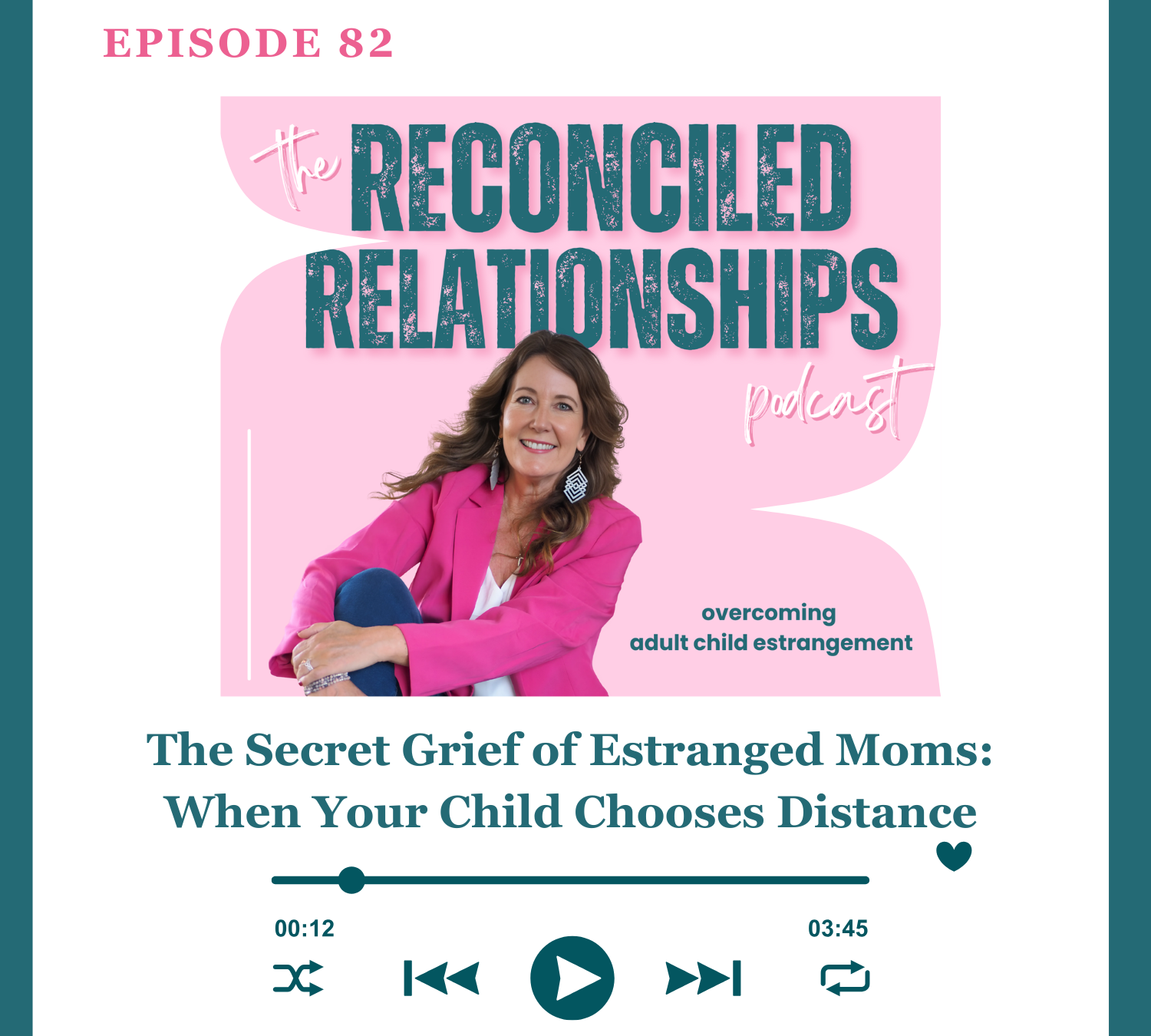
In this episode, I open my heart to moms who know the quiet ache of estrangement. When your adult child chooses distance, the grief is unlike any other—your child is alive, yet the bond feels lost. Experts call this an ambiguous loss, but I know firsthand how heavy, invisible, and isolating it can feel. That’s why I’m sharing four powerful tools that helped me begin my own healing.
First, I talk about the life-changing role of radical self-compassion—treating ourselves with the same kindness we’d offer a hurting friend. Then I share how setting emotional boundaries can protect your peace, even while holding onto hope for reconciliation. We also dive into the importance of finding a supportive community that truly understands this unspoken grief, and why focusing on your own healing and growth brings freedom in the midst of uncertainty.
This episode isn’t just about strategies—it’s about reminding you that you are not broken, you are not alone, and your worth isn’t measured by your child’s choices. Healing is possible, and every step you take toward compassion, boundaries, community, and growth brings you closer to peace.
KEYPOINTS FROM THIS EPISODE
Estrangement is an ambiguous loss that feels confusing and isolating.
Radical self-compassion is the first step toward healing.
Boundaries protect your peace without lessening love for your child.
Support networks ease the burden of disenfranchised grief.
Focusing on personal growth creates hope and healing.
QUOTABLE MOMENTS
Self-blame keeps you trapped. Self-compassion sets you free.
Boundaries don’t mean you stop loving your child; they mean you protect your heart.
Connection will make the burden lighter.
You do not have to, nor should you, walk this journey alone.
Rediscover who you are beyond being a mom.
Healing yourself is something you can control.
Your worth isn’t measured by your child’s choices.
Hope deferred makes the heart sick, but healing is never wasted.
You are enough and you deserve healing.
TRANSCRIPT OF THIS EPISODE
If you are watching this, I know you're carrying a grief that most people never talk about, and it's the heartbreak When your adult child chooses distance, you know, experts call this an ambiguous loss because your child is still alive, yet the relationship feels gone. It's like grieving someone who is both present and absent at the same time, and that's why it feels so confusing, heavy and hard. It's hard to explain to others. I totally remember how that feels. And you may feel invisible, misunderstood, or even ashamed like I did. But you are not alone and you are not broken. And today I'm gonna share four powerful tools that help estranged moms heal, starting with the one thing that changes everything, which is self-compassion. So let's dive in. Number one, practicing that radical self-compassion. [00:01:00] Radical is a word that you've been hearing a lot lately in different areas. But let me tell you, when it comes to self-compassion, you can be radical. The first and most essential step is that because this ambiguous loss often makes moms blame themselves. We replay every mistake and wonder what we could have done differently. But healing starts when you treat yourself with the same kindness that you'd offer a friend in pain. I want you to think about that. You know, self-blame keeps you trapped. Self-compassion sets you free. A love that. And I want you to start saying to yourself, I'm human and I am learning, and I am worthy of love, even in my pain. It's a foundation for real healing. ~We ha~ the words that we speak to ourselves is just as important, if not more as the words. We speak to others, but most of us don't do it. We [00:02:00] cut ourselves and we allow the enemy to get in our mind, and we replay these negativ, the negativity and the negative thoughts and the past mistakes over and over and over. And we have no self-compassion for ourselves. So that stops today. Number two is setting healthy emotional boundaries, right? Not just with your child, but with your own thoughts and emotions. So this ambiguous loss, it creates uncertainty that can consume your entire day if you let it. I have a lot of clients that are feeling this way. I remember very clearly what that feels like, and it wasn't until I made some changes ~like giving yourself permission. ~Like giving yourself permission to feel the grief, but also permission to protect your peace. Limit the time that you spend checking social media or replaying these memories. You know, boundaries doesn't mean that you stop loving your child. They mean you're protecting your own head and heart while you're still holding out for that [00:03:00] hope. So if you are a mom and you're tired of living in this constant pain and you wanna take your first steps towards some peace, I'd love to invite you to a discovery call. It is a call where you and I would have a conversation. It's not a coaching call, so please keep that in mind, but it gives me an opportunity to learn more about what's going on and how it's affecting you. More importantly. And for deeper transformation, I also host retreats. And we have one upcoming here in October. October 10 and 11 here in Ellenton, Florida. And that is going to be specifically for moms walking through estrangement. It's two days practical support, guest speakers, genuine connection, and you are going to feel a lot lighter when you leave. So both of the details for those are below in the show notes or description. Number three is building a support network. Crucial, crucial, crucial. Step one. You know, you need to surround yourself with people who [00:04:00] truly understand, you know, this ambiguous loss. It's often called disenfranchised grief, meaning society doesn't fully recognize or validate it. You know, we often talk about how when someone passes away, they send a meal train, right? Someone organizes a meal train, so, so that the family's taken care of, their meals are covered, all of that. That doesn't happen with estrangement, and this is grief, but it's not fully recognized or validated by many, and that's why it feels so isolating, and you're afraid to go out and talk to maybe new people, but also people that are in your world and in your life, because you don't wanna have to talk about it. But connection, I promise you will make the burden lighter. That's why you need to come to the retreat. It'd be a beautiful opportunity to meet new friends and if you're afraid of coming, because you're coming alone, don't be, majority of the moms are coming alone, but you aren't gonna be alone once you walk through that door. So whether it's the retreat, it's a [00:05:00] group coaching, whatever it is, a community, you have to find your people because you do not have to, nor should you walk this journey alone. And lastly, number four is focusing on your own healing and growth. You know, what happens if we start shifting our focus from fixing a relationship that we don't have full control over to healing yourself? You know, this type of loss will always carry uncertainty. We don't know exactly when it's gonna be healed, but you can choose certainty in your own growth 'cause you have control over that. So rediscover who you are. Beyond being a mom, new hobbies, deepen your faith. Invest in yourself that allows you to create some space for peace and hope for tomorrow. Because hope deferred makes the heart sick, my friend. And whether reconciliation happens next week, next month, or next year, [00:06:00] your healing will never, ever, ever be wasted. So remember, this type of loss is very real. But it does not and cannot define you. Your worth isn't measured by your child's choices. You are enough and you deserve healing every single one of you. So if this video encouraged you, give it a thumbs up, share it with another mom who needs some hope today, and I will see you in the next episode. God bless.
BOOK A DISCOVERY CALL

SHARE THIS EPISODE TO