WATCH THE EPISODE BELOW
LISTEN TO THE EPISODE BELOW


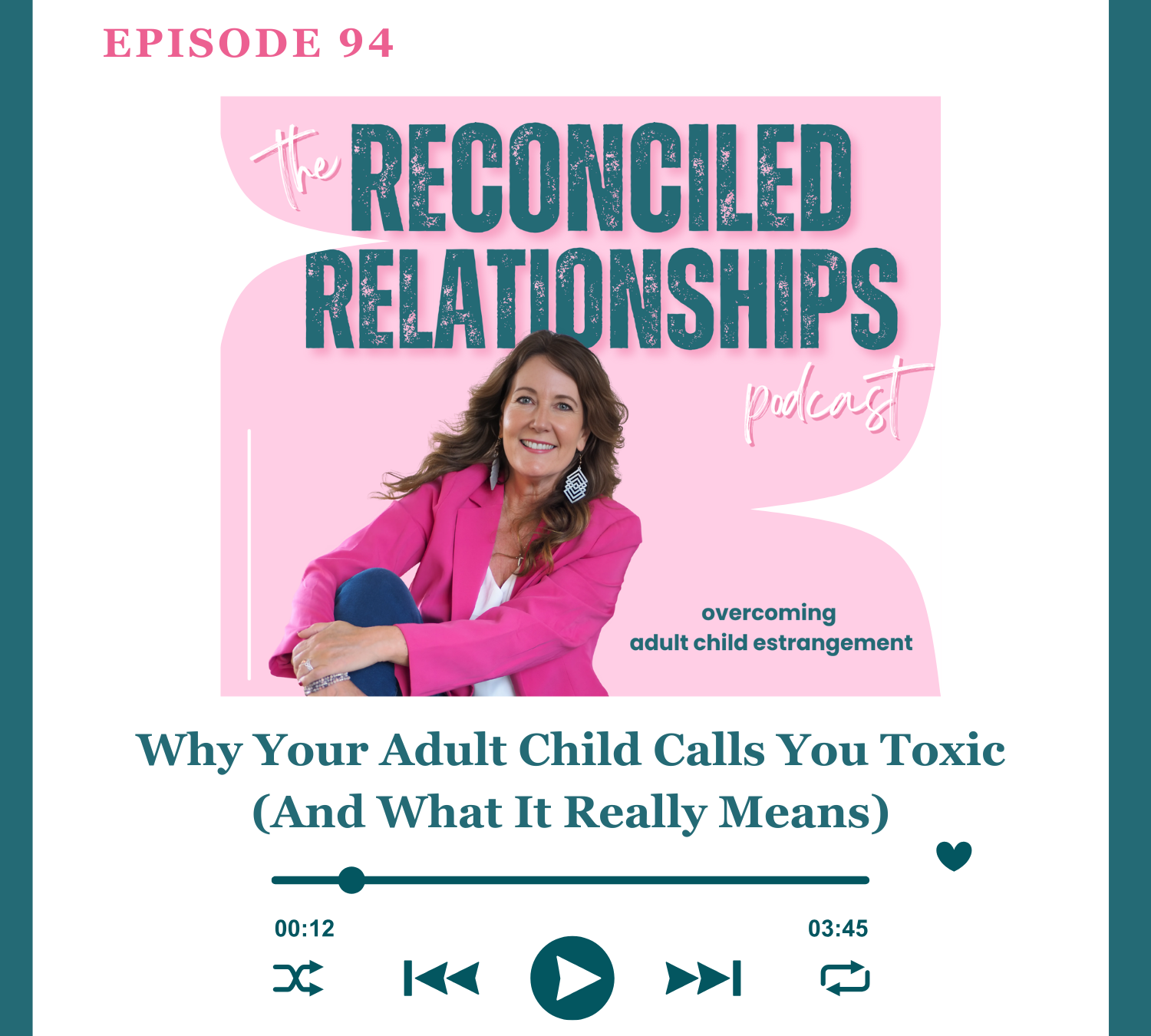
In this episode, I dive into what it really means when your adult child calls you toxic. Many moms feel shocked, hurt, or even confused when labeled this way, especially when they know they’ve done their best. I unpack why this word might not reflect your true character and how social media and cultural messaging have turned “toxic” into a default explanation for any discomfort. Sometimes, what feels like judgment from your child is actually more about their need for autonomy and growth rather than your mistakes.
I explain the difference between being imperfect and being toxic. Imperfection is human—we all make mistakes, handle stress differently, and learn as we go. Toxic behavior, on the other hand, involves patterns of manipulation, cruelty, or intentional harm. Most moms I work with are loving and devoted, and their worth shouldn’t be defined by isolated moments. It’s also important to understand what your child is truly communicating—they may feel controlled, overwhelmed, or seeking independence, not necessarily condemning your character.
Finally, I share practical ways to respond without losing yourself. Instead of reacting defensively, pause, validate emotions without taking on false blame, and demonstrate your growth through calm, loving behavior. Leading with love and setting boundaries helps keep the door open for healing. The goal is to nurture yourself first, while also preparing your family for healthier connections in the future.
KEYPOINTS FROM THIS EPISODE
-
The word toxic is often a social media-driven default for uncomfortable feelings.
-
Imperfect behavior does not equal toxic behavior; imperfection is human.
-
Adult children may call parents toxic to express their need for autonomy.
-
Avoid reacting defensively; validate emotions without accepting false blame.
-
Lead with calm, love, and personal growth to foster healthier family connections.
-
Healing is possible without proving yourself; focus on self-care first.
- Division in families is increasingly common, but awareness and intentional action can stop it.
QUOTABLE MOMENTS
-
Sometimes your child’s toxic label has more to do with them than you.
-
Social media has made toxic the default word for any uncomfortable feeling.
-
Imperfection is human; toxic behavior is a pattern of manipulation or harm.
-
Most moms love deeply, try their best, and shouldn’t be defined by one moment.
-
Your child may be seeking autonomy, not condemning your character.
-
Pause, don’t panic, and respond with calm instead of defensiveness.
-
Validate someone’s feelings without accepting blame for things you didn’t do.
-
Lead with love and demonstrate your growth quietly through your actions.
- Healing starts with you, and your example can guide your family toward healthier connections.
TRANSCRIPT OF THIS EPISODE
So your adult child just called you toxic and you're sitting there thinking, I wasn't perfect, but I wasn't. That here's what's really happening when they use that word. Why it might have nothing to do with what you actually did. ~So ~I have four points for you today on this. This is a very common situation that I'm hearing over and over again, and I wanna dive right into this. Okay. Number one is what I'm calling the social media effect, because my friends, this is really what it boils down to is it's a label that has become the default. It's a default explanation for any uncomfortable feeling. And if you think back, it makes total sense,~ right?~ If you were to impose a boundary on your adult child for whatever reason, automatically you're [00:01:00] toxic. ~Um, ~maybe you said no to something, all of a sudden you're toxic. Maybe you're not agreeing with their choices, you're toxic. Maybe you're holding them accountable, you are toxic. ~So ~they're absorbing messaging ~online, culturally and ~online that tells them that if someone challenges you just cut them out. ~And ~that is not emotional maturity, as we know that is complete avoidance. So it makes them feel empowered, like they've made a really tough decision to cut mom or cut mom and dad out. But I'm going to empower myself to do that. Now, mind you, there are times and situations, and I always feel like I have to say this, there are times where it is warranted. I understand that. So if you're an adult child watching this, I get you. I understand. I've seen some of these cases myself, but you can acknowledge someone's feelings without agreeing with ~a. ~A complete diagnosis of it, right? You don't have to [00:02:00] agree on everything. It does not equal emotional maturity. So what I want you to learn from that is that your child may be using this big toxic word to express something a lot smaller than what it had. What you are seeing ~on the out ~on the surface, on the outside, there's just this unclear emotion. Nobody's really working on or working towards trying to navigate or figure out, but social media is telling them, Hey, that means this person is toxic. So let's dive into ~what, ~what is the difference between imperfect versus toxic? ~Secondly,~ let's, let's draw the line here so we both know what these words mean, but for review, toxic ~is. ~Could be a pattern of manipulation, cruelty, control, maybe intentional harm, all of these kinds of things. That would be someone who is toxic, imperfect. ~Hello. ~That is all of us. Everybody raise their hand [00:03:00] 'cause that's you. That's me. It's human mistakes. We handle stress differently. Sometimes we go into survival mode and my friends, we learn as we go. ~Right? So ~most of the moms. That come to me, especially the moms ~that ~I serve, that I end up, you know, taking on as clients. These moms are moms that love deeply, tried their best, did their best, didn't always get it right, and shouldn't be defined by the worst moment, ~right?~ ~We, ~when you think about it, our childhoods and our, our family, all the moments ~that ~we've had with our families, if you put 'em all jumbled up together. We're only gonna define the family by this worst moment or moments, right? Your adult child is like evaluating the past with this understanding where we're just gonna grab the worst moment, and that feels like such judgment. A mistake is something ~that ~you can grow from a [00:04:00] label. A label is something that people try to trap you in or. You trap yourself in. I know a lot of people who like to live by labels of either a diagnosis or they just start claiming that they are anxiety. I have anxiety. I have depression. Does that mean you don't have those emotions? Of course it means you do. You have the emotions, you have the feelings, but don't label yourself that way, right? You get trapped by those labels, ~so. ~If you are a mom navigating this path, I ~do ~offer a guided call to help you find some clarity and direction in your healing process. This call is for moms to figure out if my one-on-one coaching or group coaching is a good fit for you, but I wanna be able to help you navigate what is your next best step for yourself in this difficult season that you're going through in estrangement. So if that's you and you're ready to consider getting some guidance in a coaching program. Then [00:05:00] I welcome you to book that call, and the link to that is in the show notes below. Number three is what are our kids actually communicating? You know, like I mentioned, a lot of adult kids are using this word toxic, when really what they're trying to convey ~to us ~is that maybe they felt controlled. Maybe they want to make their own decisions. Maybe they're overwhelmed by their own emotions, their own traumas. Sometimes it's less about your character and more about their need to run their own life, the autonomy of it all. They're trying to rewrite the story of their life, which sometimes means pushing away anything that reminds them of being dependent, like, you know what, mom or mom and dad like, they tried pushing. They tried running my life all these years. Well, I'm gonna set them aside right now so I can walk into my own future. I hear these things all the time, [00:06:00] and really it's about where they are in their own growth, ~right?~ And there's nothing wrong with ~want ~them wanting to have their own life and ~be, you know, ~have autonomy in their own life ~and, ~and build their own families. That's what we want for them, but it doesn't mean we always have to set people aside. Lastly, number four is what is your next move? What is your next move without losing yourself? Because the temptation when you're being called these things is to defend. Try to explain, prove yourself, prove your heart. But I loved you so much. I did ~this or ~this and this, and defend yourself. But what ends up happening there is that will lead to more distance. They'll say, there you go again. Trying to defend yourself. There you go again, trying to make excuses because they're not ready to hear these things. ~And so ~what I would encourage you to do is to pause. Don't panic over these words. Don't panic over the things that they're saying. I want you to get curious about what they're saying instead of [00:07:00] defensive. You know, you can validate someone's experience or validate their emotions without accepting the blame for something ~right. ~Now, by all means, if there's something that they're accusing you of and you did, ~do ~you have to own that. I want you to lead with love. I want you to lead with calm, love, and ~so ~demonstrating your own growth quietly through behavior. Not begging, ~right, ~not being needy. ~So ~stopping the begging ~you, ~working on ~you, ~you taking care of yourself, and you slowly get to show them that over time. I want you to do it for you. The benefit is that they get to benefit from it. The benefit is your family will grow stronger, your marriage will get better, ~all of these things, ~but I want you to do it for yourself to begin with. ~You know, you can.~ There's nothing wrong with saying, you know to them like, I understand that you're hurting, and when you're ready, I'd love to understand what you needed that you didn't get. And then when given that opportunity, you need to listen. That shows maturity on your part. It keeps the door open. [00:08:00] And just remember that you don't have to accept a false label to be open to healing. We have to meet our kids where they're at, and a lot of our kids don't understand that they need to. They really do need to meet us where we're at. But the whole goal here, if the enemy has attacked your family and you have had this division. You need to take this time. We need to fight against the enemy, but you need to use this time so wisely so that this never happens in your family again. This needs to stop here. Division in Families is becoming as rampant as addiction,~ right?~ ~One in three,~ one in four families are dealing with the same thing that you're, that you're dealing with right now. If you're watching this video or listening to this podcast. So I wanna encourage you, like, utilize your time. We need to fight, but don't fight your son or daughter. Fight the enemy who is doing all of [00:09:00] this in the spiritual, right? This isn't just the natural realm here, and whether you believe that or not, I promise you it's true. And so I hope that this helps you in some way. ~Uh, I'm here. If you're ready for that call, ~I'm here to, ~uh, ~walk through that with you and to ~help you ex ~help explain to you, you know, what one-on-one coaching group coaching could look like for you and how it could benefit you. And if that's something you wanna do, fantastic. If not, that's fine too. But I want you to know that you're not walking through this alone. ~So I hope this helped.~ I'll see you in the next episode. God bless.
BOOK A DISCOVERY CALL

SHARE THIS EPISODE TO